
This is the fifth chapter of my virtual book, “On Leadership“.
In the previous chapter, we looked at how you can build resilience and cultivate a “growth mindset”. These are skills you can develop to become more effective at leading yourself. In this chapter, we will use the “circle of influence” tool and learn how we can empower ourselves by focusing our time, attention and energy on what we can do rather than what we cannot do
This concept of the “circle of influence” dates back from the book “The Seven Habits of Highly Effective People” by Stephen Covey. While it was published originally in 1989, it remains one of the most influential books about personal effectiveness and is well worth reading. Let me share the concept with you here, in case you have never heard of it or would benefit from a refresher:
Imagine all the things in life that you are concerned about: these may be things such as your work, your family, the weather, your favorite sports team, your health, and may other things. All of these things can be put in a circle we can call the “circle of concern”. This circle includes things that you can directly control, things you can influence, and things you can do nothing about.
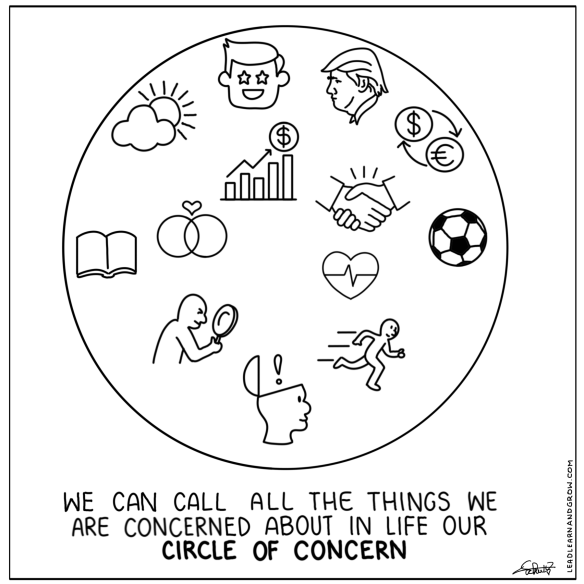
We can take everything in the circle of concern and sort them into two categories: things over which we can exert at least some influence or control, and those things over which we can exert no influence or control.
Some examples of things we cannot influence at all include the weather, the performance of our favorite sports team, exchange rates, the moves by our competitors and most politics – unless you decide to run for office! These things remain in the “circle of concern”.
One thing that ALWAYS remains in the circle of concern are things that happened in the past. We spend so much time and energy replaying things that already happened, telling ourselves how unfair such-and-such a situation was, regretting decisions we made, complaining about past injustices. And we can do nothing about these things, because they have already happened.
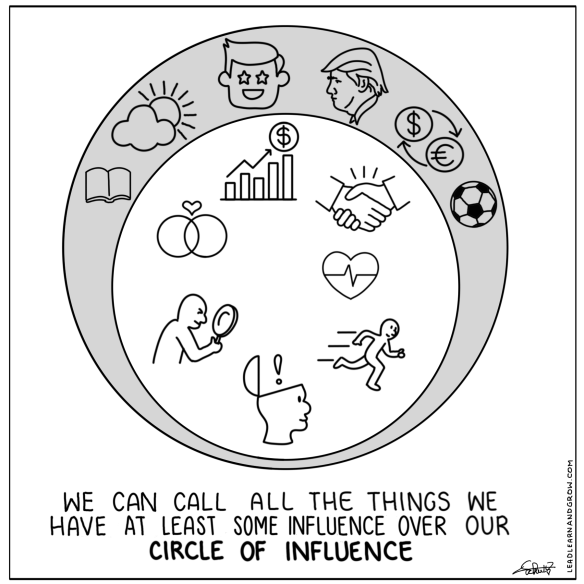
Some examples of things we can influence, at least to some degree, are the actions of our friends, family members and colleagues. We can influence the work we do, our own feelings and, of course, our health and wellness through choices we make about diet, exercise and getting enough rest. These things can be put in a circle called the “circle of influence”, which sits inside the larger circle of concern.
The things in the “circle of influence” can be further sorted into two categories: things over which I can exert complete control, and all the remaining things which I can only influence but cannot completely control.

There are many things in life which we can influence to a greater or lesser degree, but there are only three things over which we can exert complete control:
- Our focus – we can choose what to focus our attention, time and energy on. Even if we get distracted, we can always choose to refocus on what is important to us.
- Our interpretation – while it is not always easy (and we will discuss it further in a future chapter), you alone can decide whether the proverbial glass is half full or half empty.
- Our actions – we may feel obligated to act in certain ways, but in reality as a human being, we are fully in control of the next step or action we take. Even with a gun pointed at us, we can choose whether to resist or comply.
We can place the things we can completely control within a circle called the “circle of control”, which sits inside the larger circle of influence, which sits inside the larger circle of concern.
And here is the power of the “circle of influence” tool:
Which circle offers us the best return on investment on our energy spent? In other words, if we are going to use our emotions, our time, our thoughts and our efforts, which circle is the most worthwhile to use them on?
The circle of control offers the best return on investment, because 100% of our energy delivers a result.
Let’s turn this on its head and look at it in another, simpler way:
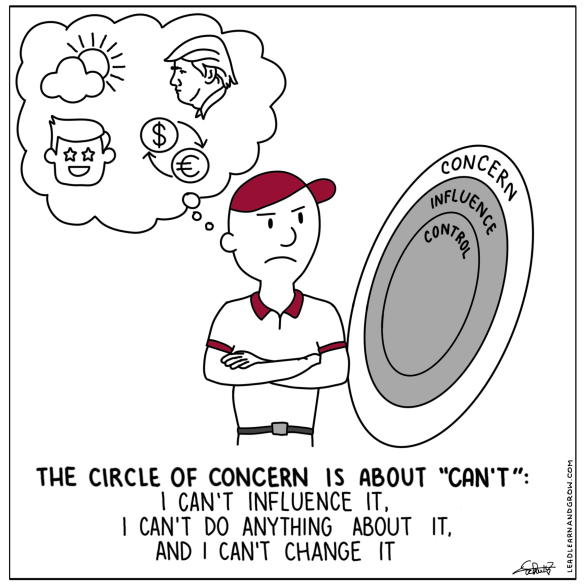
The circle of concern is the circle of “can’t”: I can’t influence it, I can’t do anything about it, I can’t change it.
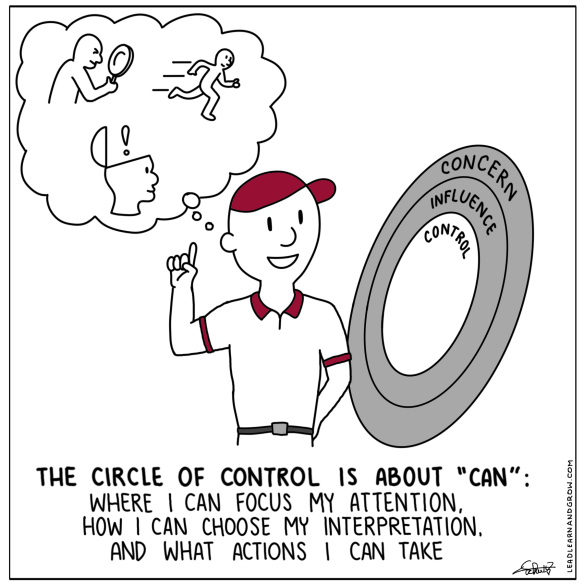
The circle of control is the circle of “can”. I can choose what to focus on. I can choose how to interpret the situation. I can choose how to act.
Which one is more useful to spend your time and energy on? Of course, the circle of “can”!
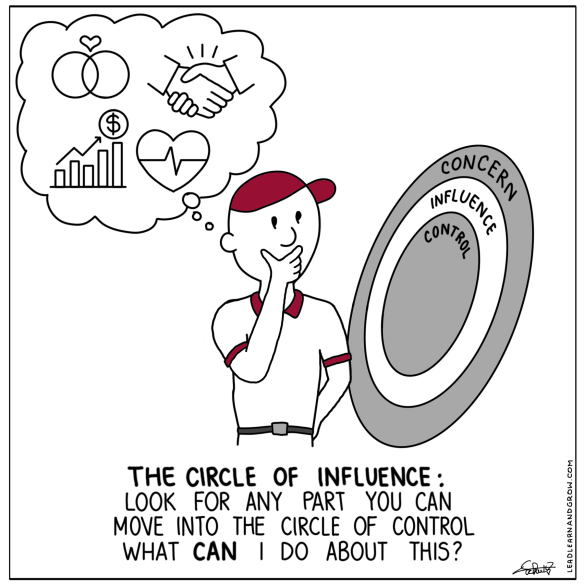
What about the circle on influence? What should we do about that? Well, for any item that is inside the circle of influence – meaning that we have some influence on it but not complete control – we simply ask, “What part of this is within my circle of control? What CAN I do about it?”
Let’s look at a work-related example:
You have a boss who is very demanding, always correcting what you believe to be tiny details in your work that you think aren’t very important. You are frustrated by your boss and consider him to be too picky. He should lighten up!
It may not feel like it, but your boss and his actions are within your circle of influence. Simply focus on what you CAN do about the situation. Remember the three things that are wholly within your circle of control: your focus, your interpretation, and your action.
- Your focus – you can choose to either focus on what your boss is saying to you and try to learn from it, or you can choose to “tune him out” and ignore his corrections. The choice is up to you what to focus on.
- Your interpretation – you may initially interpret your boss’ actions as demanding, overly-detailed and picky. But if you try hard enough and look at things from his point of view, you might see the situation differently. Maybe there is a reason that these details are important, a reason that you don’t yet realize. The choice of how you interpret the situation is up to you.
- Your actions – you have a choice whether to take your boss’ feedback and give more attention to the details of your work. You could also choose to speak with your boss and ask him to explain the importance of the details, so you understand the impact of your mistakes. You could also choose to quit, if you decide it isn’t worth your effort to change yourself. Quitting may have consequences, but it is a choice that is fully in your own control.
When you look at it this way, focusing on what you CAN do rather than what you CAN NOT do, is incredibly powerful. In every single situation in life, you CAN choose your focus, interpretation and action. And this allows you to truly lead yourself, because realizing that you CAN do something lets you move from feeling powerless to being powerful.
One more look at the circle of concern, the group of things over which we have no influence or control. Is this circle completely useless? Is there anything we can do with it? Thankfully, the circle of concern has some value. We can do one of four things with something that rests in the circle of concern:
- We can look for some way to change it – or to change ourselves – nudging it from the circle of concern to the circle of influence.
- We can accept it and learn to live with it
- We can leave it – if it really is so bad, maybe we need to walk away
- We can learn from it – especially things that happened in the past, what lessons can we learn and apply to the future?
Here is an easy exercise you can practice this week to strengthen your ability to lead yourself:
- As you encounter difficult or frustrating situations and find yourself saying (or thinking) that you CAN’T do this, or CAN’T do that, pause for a minute and change your words: instead of saying what you CAN NOT do, trying saying what you CAN do. Or, at the very least, what you MIGHT be able to try doing.
- Set an alarm bell in your mind that rings every time the word “CAN’T” crosses your mind or your tongue. By shifting your vocabulary from CAN’T to CAN, you will focus on your circle on control and lead yourself more effectively.
In the next chapter, we will continue exploring ways you can lead yourself and introduce the concept of practicing emotional intelligence.
As always, we welcome your input and feedback: leave your comments below or drop us a message. And please follow me on Instagram: @leadlearnandgrow
 Lead Learn and Grow
I choose to focus on what I can control
LikeLike